Kawasaki Ninja H2 : Kawasaki’s Ninja H2 has always sat at the very top of the hypersport ladder, and the 2026 model only sharpens that position.
With a brutally powerful supercharged inline‑four, a razor‑sharp chassis, and electronics that feel more like a MotoGP bike than a street‑legal machine, the latest H2 is less of a motorcycle and more of a rolling engineering statement.
For riders who live for acceleration, track‑day drama, and cutting‑edge tech, the 2026 Ninja H2 is still one of the most compelling – and intimidating – propositions in the entire two‑wheeler world.
Engine and Performance: Power That Feels Unnatural
At the heart of the 2026 Ninja H2 lies a 998cc, liquid‑cooled, inline‑four engine with a mechanical supercharger, tuned to deliver around 240 horsepower at roughly 11,500 rpm and about 105 lb‑ft (142 Nm) of torque near 11,000 rpm.
That kind of output translates into acceleration that borders on surreal: 0–100 km/h arrives in the low‑three‑second range, and top speed comfortably exceeds 300 km/h on the right stretch of road or track.
Kawasaki has spent years refining how that power gets to the rear wheel, and the 2026 H2 benefits from a more linear, controllable delivery than earlier iterations.
The six‑speed dog‑ring gearbox and chain final drive are built to handle the stress, while the supercharger‑assisted torque curve keeps the bike lunging forward even in the mid‑range, making it terrifyingly quick out of corners and on highway roll‑ons.
Chassis, Suspension, and Brakes: Taming the Beast
To keep all that power usable, Kawasaki pairs the H2 with a high‑tensile steel trellis frame and a compact swingarm that prioritizes stiffness and feedback.
Up front, a 43 mm inverted Kayaba AOS‑II fork offers fully adjustable rebound and compression damping plus preload, while the rear Uni‑Trak setup with an Öhlins TTX36 shock gives 24‑way compression and 15‑way preload adjustability. Together, they turn the H2 from a straight‑line missile into a surprisingly composed track tool.
Stopping duties fall to dual 330 mm semi‑floating discs up front, gripped by radial‑mount Brembo Stylema calipers, and a single 250 mm disc at the rear with a two‑piston unit.
Kawasaki’s Intelligent anti‑lock Brake System (KIBS) adds cornering ABS, while traction control, launch control, and an electronic steering damper help keep the rider in control when the supercharger really wakes up.
Electronics and Rider Aids: Track‑Level Tech on the Street
The 2026 Ninja H2 leans heavily on a six‑axis IMU‑based electronics suite that underpins Kawasaki’s Cornering Management Function (KCMF), traction control, engine‑brake control, and quick‑shifter.
Riders can switch between multiple riding modes, each altering throttle response, power output, and intervention levels to suit street riding, spirited back‑road runs, or full‑on track days.
A full‑color TFT display sits behind the aggressive fairing, showing speed, RPM, gear position, ride‑mode status, and connectivity features via Kawasaki’s RIDEOLOGY app.
Some markets are also seeing advanced rider‑assistance systems trickling down from the H2 SX and H2 SX SE, including radar‑assisted safety functions and adaptive cruise‑type setups, though these are more common on the sport‑touring siblings than the raw H2 itself.
Design and Aerodynamics: Futuristic, Aggressive, and Functional
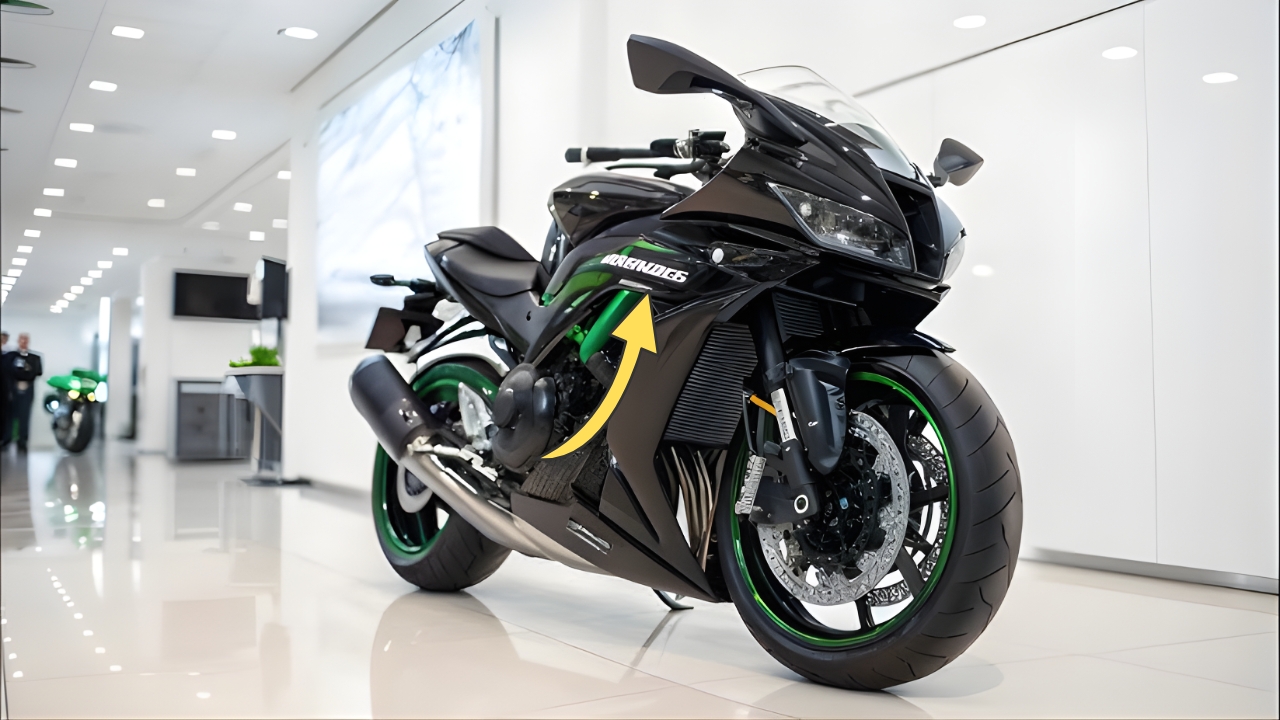
Visually, the 2026 Ninja H2 still looks like something that escaped from a wind‑tunnel lab. The front end is dominated by a sharp nose, angular LED headlights, and integrated winglets that help manage airflow and high‑speed stability.
Carbon‑fibre bodywork is available on the H2 Carbon variant, which swaps some panels for lightweight composite pieces and adds a gloss‑black/mirror‑coated paint scheme that gives the bike a more exclusive, track‑ready look.
Kawasaki has also tweaked the ergonomics slightly over the years, with a relatively aggressive but manageable riding position that balances comfort for short‑distance touring with the need for firm control at triple‑digit speeds.
The 17‑inch wheels, wrapped in sticky 120/70 front and 200/55 rear rubber, complete the package with a stance that screams “track‑first, road‑second.”
Also Read This : Realme 16 5G – 120W fast charging smartphone with snapdragon processor
Kawasaki Ninja H2 Market Position and Ownership: Not for the Faint‑Hearted
In India, the Ninja H2 sits in a tiny, ultra‑premium segment, with ex‑showroom prices starting around ₹35 lakh for the standard variant and climbing into the mid‑40s for the Carbon model, while the track‑only H2R has historically crossed ₹70 lakh before being effectively discontinued in many markets.
Globally, pricing typically begins in the mid‑$30,000 range, making it a niche machine aimed at serious enthusiasts, collectors, and track‑day obsessives rather than everyday commuters.
For 2026, Kawasaki continues to treat the Ninja H2 as a halo product: limited production, cutting‑edge engineering, and a reputation for being one of the fastest, most advanced production motorcycles on the planet.
If you’re after a bike that blurs the line between street machine and race‑bred hyperbike, the 2026 Kawasaki Ninja H2 remains one of the most convincing answers – as long as you’re ready to handle its sheer intensity.